


Strange Tales from QIU Jiongjiong’s Cinema
On September 25, 2026, Qiu Jiongjiong’s solo exhibition, Fu Xi: A Feast for the Universe, opened at A4 Art Museum in Chengdu. The exhibition takes its cue from his latest film, Fu Xi, which Qiu has described as an anthropological field study with a mischievous streak. In the museum, the film spills into painting, sound, moving images, and installation. Three chapters unfold across two dimensions, one black, the other white, gathering into something like a banquet ritual. It begins with Fu Xi, but soon seems to have a life of its own.
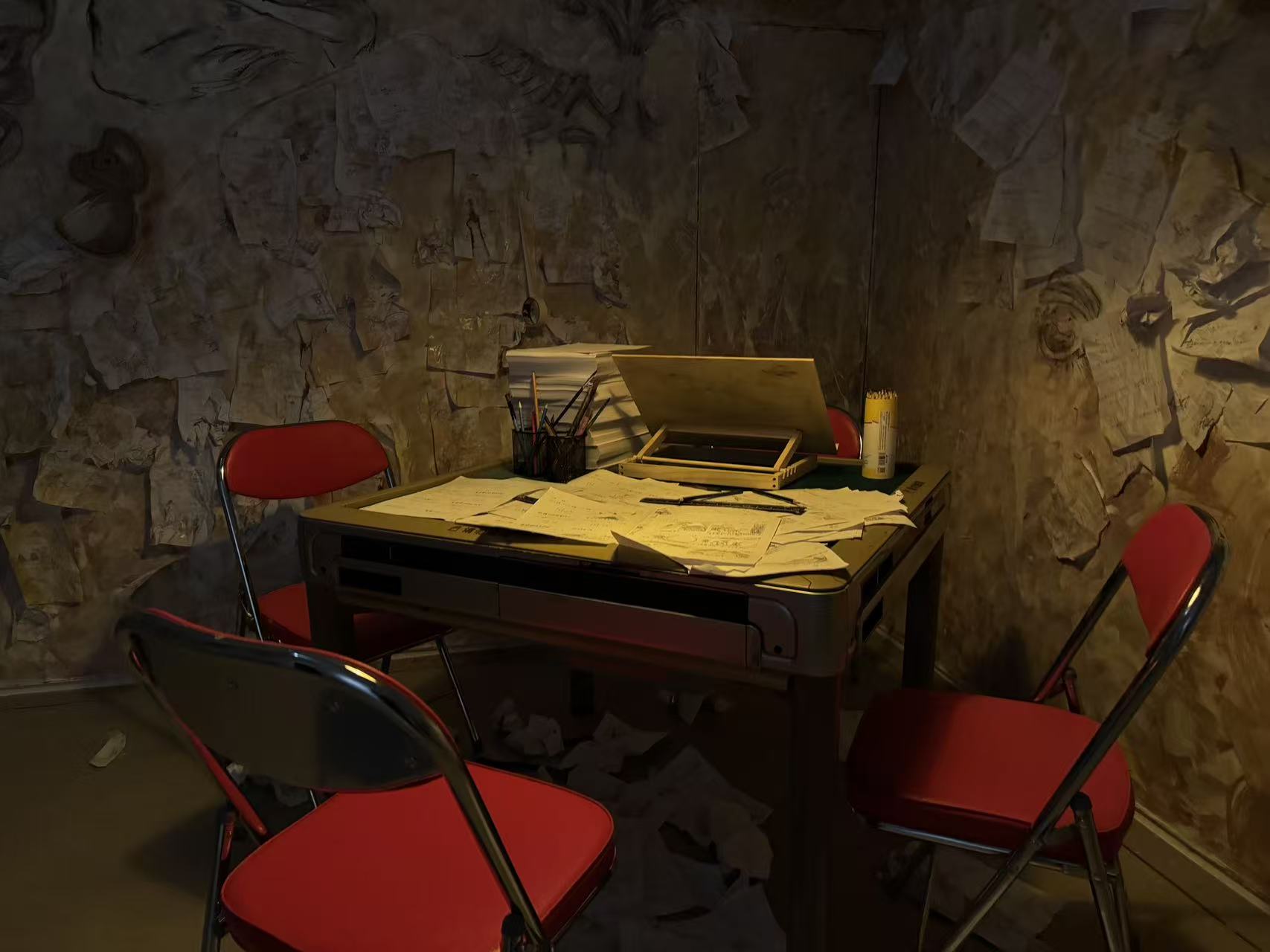
Upon entering the gallery, look to your right. Behind a curtain in the corner is a small space called the Studio. Inside, there is a mahjong table, four red folding chairs, a tall stack of paper, and walls covered in sketches. This is Qiu Jiongjiong’s worktable.
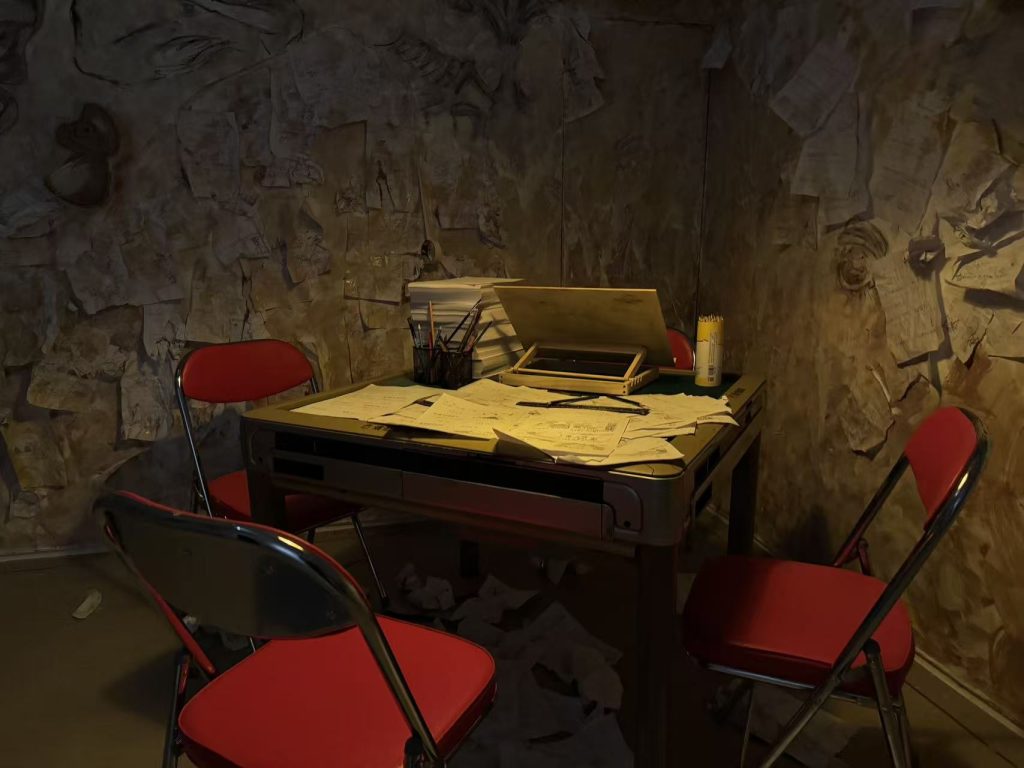
An artist’s worktable is not usually something we are invited to look at. There is nothing particularly impressive about it, at least at first glance. It might look much like yours or mine. We tend to imagine filmmaking in terms of crowds, money, and commotion; a film’s release brings red carpets, applause, and prizes. The work that precedes all this is harder to picture. It is usually summed up with a shrug: it wasn’t easy.
But what happens at a worktable? Years of drawing, revising, and starting over. Anxiety, solitude, cigarette butts, a pencil worn down to the nub. The daily business of making something when there is no guarantee that it will work. And yet, for all the frustration involved, there is also pleasure. Looking at Qiu’s work, I keep returning to this combination of doggedness and delight, already apparent in The Moon Palace.
His first film contains much of what would come to define his work: a taste for strange tales, an irreverent attitude towards form, and a feeling that anything might happen. It is loose in construction but remarkably sure of its own temperament. From there, Qiu kept going.
Between 2006 and 2011, he made Ode to Joy, Portrait of Mr. Huang, Madame, and My Mother’s Rhapsody. The films vary in form and subject, moving from family histories to portraits of people around him, and then to old Sichuanese talking about their lives. Their stories are full of colour, candour, and the kind of earthy detail that refuses to be tidied away. One can watch them as documentaries, or as carefully fashioned portraits. Seen together, they begin to suggest something else: a creature with a mischievous disposition, already twenty by Chinese nominal age but barely five in the world. It has been digging underground, listening, collecting stories, and occasionally poking its head out to see what everyone is up to.
Four years later came Mr. Zhang Believes. Here, the handmade cinema that would shape Qiu’s fictional world began to take form. But the film’s pleasures extend beyond its ingenuity. Memory and oral testimony become a labyrinth of their own, full of digressions, contradictions, and stories that change in the telling. The past, in Qiu’s hands, rarely stays where it is put.
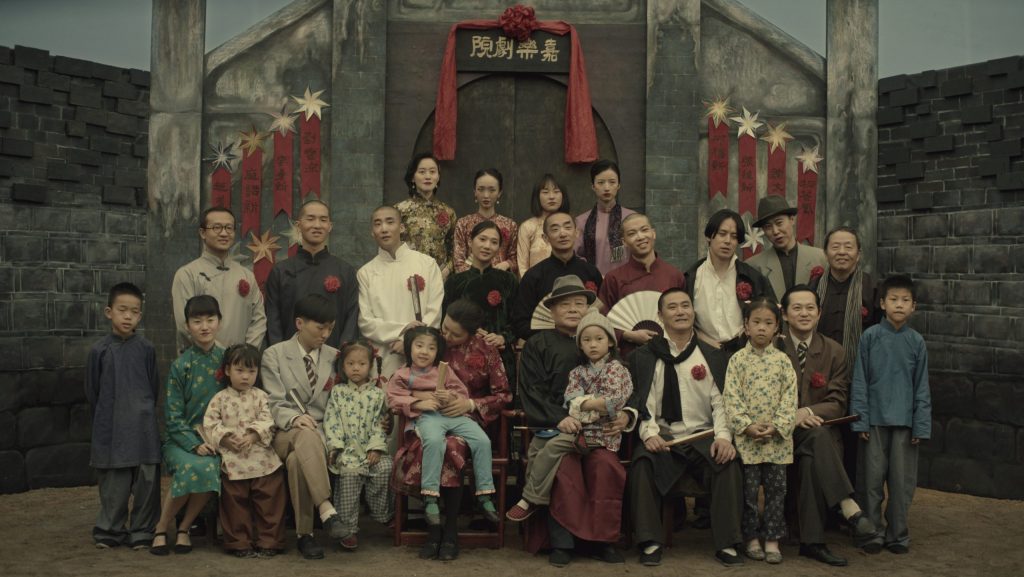
Six years later, A New Old Play astonished audiences with the scale of its invention. Told in Sichuan dialect, it moves through history with an extraordinary lightness of touch. Its theatrical world is at once absurd and deeply felt, its handmade artifice never diminishing the weight of what it carries. History rolls on, indifferent to the individual, yet somehow there is room for resilience, mischief, and the stubborn business of living.
On September 29, I visited the exhibition in Chengdu and met Qiu. We talked about his early transition from painting to theatre, and about the worktable process behind A New Old Play. As he warmed to the conversation, his head began to sway to a rhythm of its own. For a moment, I thought of Qiu Zhimin, the man from The Moon Palace who measured his drinking capacity in tons. Only this time, the role was being played by his son. Watching him, I found myself thinking that he must have an excellent neck.
That day, I also met Classmate Lü, the slightly unhinged drunkard from The Moon Palace. Years later, he would become the art director of A New Old Play and play an important role in the early development of Fu Xi. After enough hours alone at the worktable, perhaps the thing to do is round up your gang and start a filmmaking summer camp.
Qiu’s films are full of familiar faces. Family members, old friends, and collaborators keep turning up, sometimes as themselves, sometimes in other guises. His niece, the talented composer Diao Lili, has been bringing her particular comic sensibility to his films since the beginning. Watch all seven films in this retrospective and you may start recognizing people before they even speak. The characters come and go, but the company remains.
I wanted this retrospective to trace the course of Qiu’s work without imposing a tidy narrative of artistic progress. The films speak to one another in unexpected ways.
The worktable exhibition grew out of this same desire to look more closely at how Qiu’s films take shape, with generous support from Qiu and his representing gallery, Star Gallery. One weekday afternoon, I received hundreds of hand-drawn sketches and concept drawings for A New Old Play, all made by Qiu himself. The earliest dated from 2017. From this collection, we selected works that offer a glimpse into the film’s visual development, from character designs and set drawings to storyboards. Reproductions of these works will be exhibited at the Cheng Yu Tung East Asian Library at the University of Toronto during the retrospective.
These drawings offer a glimpse of a film before it becomes a film: scenes taking shape, figures appearing on paper, a world being assembled one line at a time. They also remind us that Qiu’s cinema is handmade in the most literal sense. Behind the apparent freedom of his films lies the time spent sitting down and working things out.
The screening schedule has a rhythm of its own. Across two weekends in October, Portrait of Mr. Huang and Mr. Zhang Believes bring two elders and their stories into view. On another day, The Moon Palace is paired with My Mother’s Rhapsody, bringing together a cast of aunts and uncles, an eighty-year-old mother, and her sixty-year-old son. In November, A New Old Play and Ode to Joy share a double bill. Together with Madame and the five-hour director’s cut of Mr. Zhang Believes, they round out the retrospective.
A retrospective is not simply an occasion to bring a filmmaker’s works together. It is also a chance to follow the course of an artist’s creative life, to see how he finds his own language with each film while continuing to venture into the unknown.
A particular kind of comic spirit runs through Qiu’s films. He is playful without being frivolous, irreverent without losing sight of his subjects. His films can be unruly, funny, and unexpectedly moving, sometimes all within the same scene. Their creative force springs from what I can only call a genuine clown spirit.
Such freedom does not come easily. It takes courage and discipline, as well as an exacting attention to detail. And this is not enough. Passion must also be accompanied by knowledge, critical reflection, and rigour. In his work, Qiu has brought all of these qualities together.
The idea of a Qiu Jiongjiong retrospective at Mulan first took shape in 2023. Three years later, the moment finally felt right. In 2026, we were able to welcome Qiu to Toronto, where audiences could encounter both the films and the creative path that connects them.
As for Fu Xi, which is set to premiere at the Tokyo International Film Festival, when will it come to Mulan?
Qiu grinned. “We’ll meet sooner or later.”
